|
|
||||||||||||||||
 |
 |

|
||||||||||||||
 Energy Around Us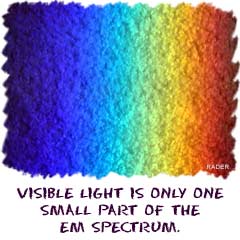 There are waves of energy and light moving around us in the form of TV and radio transmissions, gamma radiation from space, and heat in the atmosphere. Scientists call them all electromagnetic radiation. The waves of energy are called electromagnetic (EM) because they have both electric and magnetic characteristics. Physicists classify them by the frequency of their wavelength, going from high to low frequency. When a wave has a lot of energy, it could be a gamma ray or x-ray. If it has low frequency, it has less energy and could be a TV or radio wave.
Structure of EnergyAll EM energy waves travel at the speed of light when in a vacuum. No matter what their frequency or wavelength, they always move at the same speed. Some properties of waves, such as diffraction and interference, are also seen in EM radiation. Scientists have figured out that there are tiny particles in these waves. The particles have been given the name photons. The photons are specific units or packets, of energy. Sometimes those particles interact with each other and change the way the light originally behaved.Detecting EnergyAll types of EM radiation are useful to the world of science. Look at radio waves as an example. Radio stations and ham radio operators of Earth work with radio waves every day. Radio waves are used to carry communications from one point to another. Radio waves are also extremely important to astronomers. Astronomers are constantly listening to the radio waves of other galaxies to learn more about their stars. Stars give off large amounts of EM radiation across the entire spectrum and we can study that radiation to learn more about the universe.Radiation Isn't Always a Bad ThingAn important idea you should always remember is that sometimes we use the word radiation. When you think of radiation, you probably think about nuclear power plants, bombs, and X-rays. Sure, those are all types of radiation. To physicists, all light is considered radiation. That means that everything from television and radio waves to gamma rays are types of radiation. Think about the word LASER. The R stands for radiation, while a laser is just a souped-up flashlight. Think about heat. Most heat is actually infrared light being given off by an object. That heat is also radiation.

|

|
|||||||||||||||
Useful Reference MaterialsEncyclopedia.com:http://www.encyclopedia.com/topic/electromagnetic_radiation.aspx Wikipedia: http://en.wikipedia.org/wiki/Electromagnetic_radiation Encyclopædia Britannica: http://www.britannica.com/EBchecked/topic/183228/electromagnetic-radiation NASA/GSFC: http://imagine.gsfc.nasa.gov/docs/ask_astro/ask_an_astronomer.html Lawrence Berkeley National Labs: http://www.lbl.gov/MicroWorlds/ALSTool/EMSpec/ University of Oregon: http://abyss.uoregon.edu/~js/glossary/electromagnetic_radiation.html | ||||||||||||||||
|
RETURN TO TOP or Search for more information... * The custom search only looks at Rader's sites. |
|||||||||||||||
 Go for site help or a list of astronomy topics at the site map!
©copyright 1997-2015 Andrew Rader Studios, All rights reserved. Current Page: Cosmos4Kids.com | Universe | Electromagnetic Radiation |
||||||||||||||||
|
|
||||||||||||||||

